Showing posts with label HEMA. Show all posts

Monday, 30 January 2012

Uniforms redux....or maybe a rant/wibble.

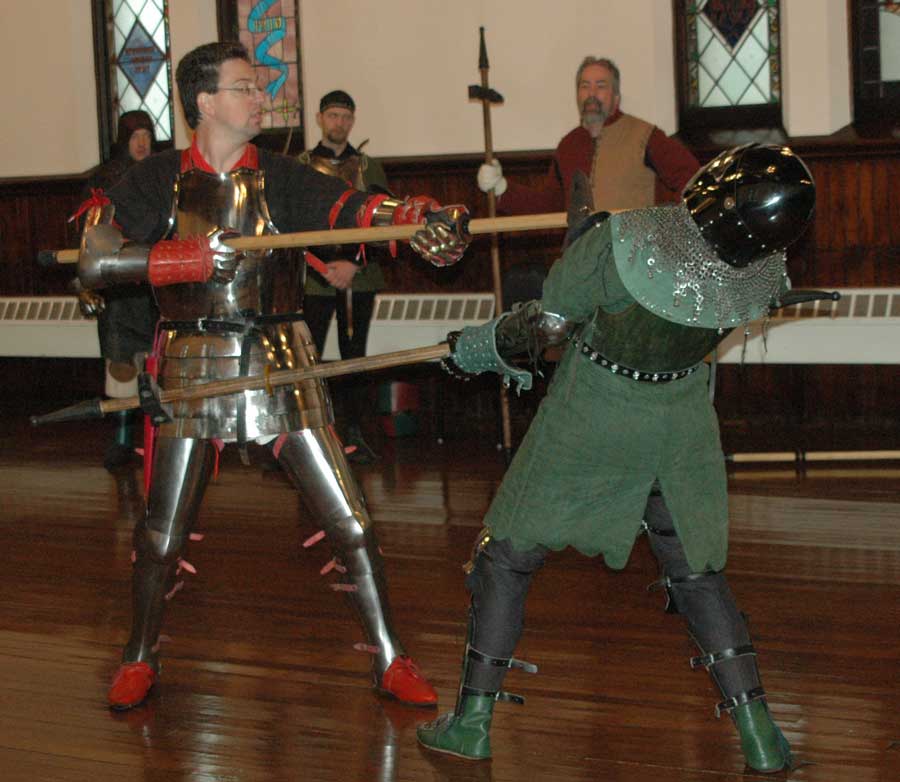
Sigh...I should like to go on record as saying that the HEMA/WMA uniform that is widely (though not wholly) adopted, is a really good thing. This "look", if you will, which might be best described as that of the "bad ass fencer" (ie. standard fencing kit...but in black), is the best thing for our little community and its growth. Sport/olympic fencing has a positive and respectable reputation in the minds of the public...and since we are fencers of a sort it only makes sense that we ought to adopt this traditional uniform.

To not do so would seem rather odd to those outside of our art.

However, while this is the uniform I wear...and will continue to do so (quite proudly too...as I cut quite a dashing figure). There are times when I long for some historical kit. What I think I need is something like Sweden's "Living HEMA organization.

Perhaps that super secret UK "living HEMA" group will one day see the light of day...one can but dream.

Wednesday, 27 July 2011

...so where do you put your hands?

Phew...been a fair spell ain't it? Sorry 'bout that and my apologies to you all.

So I was chatting with StevieT last night and he asks me just that question. At first I thought he was referring to this thread over on the HEMA Alliance, but no, he had an altogether simpler and perplexing question.

In relation to the crossguard/quillions on the hilt of a hand a half sword...where is your dominant hand (although I'd argue that either hand can fill that role in this case)?

Is it cozied up next to the cross? Or is there any space between the two?

Frankly I'd not thought much about this really...however Stevie had indeed done so, and found that he received far less cuts to the hand if he didn't leave it jammed up next to the cross. "Curious" I thought..."makes some sense" I concurred. He then strengthened his theory with the possibility of documentary evidence...so when I have the free time I fully intend to look into that side of thing.

In the mean time let's put this theory to the test. Let's put our "little grey cells" onto this theory and experiment with modifying our grip next time we have a sword in our hands.

Friday, 11 March 2011


Apparently this sort of thing is deeply offensive to some folks...personally I couldn't care less.

I do wonder why though: perhaps it is do to your own uncertainty? Perhaps it is envy?

Who knows for sure...but I do think that those that protest the loudest often have the most to lose.

anywho, my footing is secure...how's yours?

Tuesday, 8 March 2011

videos

A few random sparring videos from last nights session, some experienced folks and some new folks...there's a fair amount of promise here as well as plenty to work on*:

http://www.youtube.com/watch?v=AyITo2sozBs

http://www.youtube.com/watch?v=hE7S5lCMkE4

http://www.youtube.com/watch?v=Z3iqaRinfXs

http://www.youtube.com/watch?v=T1vi6rNZf3w

*like my filming...next week some films me perhaps?

Wednesday, 26 January 2011

A simple tutorial...part 1


Creating your own padded "Masters jacket"

You will need:
A suitable fencing jacket (I used a front opening version available from Absolute Fencing.)
A few yards of closed cell foam (I used 5mm thick foam purchased from Langans)
A few yards of suitable cloth (I used cotton broadcloth)
A few yards of Velcro
Needles and thread, scissors, etc.
Card stock

First get yourself a suitable jacket (ensuring that it is at least a size larger than you normally wear for minimal padding). I used an Absolute brand jacket solely as a cost cutting exercise...use what ever works and is affordable for you.

Once you have your obtained your component parts, you are ready to start. Begin by creating a pattern for your padding out of card stock. As every jacket (and individual) is different I will not provide a pattern here...start by laying out your jacket over the card stock and trace the outline. Then simply remove the portions of card that are not required to form your pattern. Don't forget to try on your jacket with the card stock pattern inside...this will help you decide what areas still need to be trimmed. You will want to avoid bunching/wrinkles wherever possible to ensure a decent fit. Make sure that your padding covers those areas that you would like to protect. I would humbly suggest that the clavicle, sternum, cervical vertebra, and kidneys are the minimum locations on the torso that I would protect.

Next, sew covers for your foam inserts using the patterns you made earlier...don't forget to make them slightly larger to allow for the thickness of the foam and the stitching.


Now you are nearly finished...just fit the foam inside the covers and sew up the openings...this is the last chance to ensure that everything fits, so have a fitting.


Last step...no you aren't finished quite yet. These pads aren't going to stay in place on their own are they?

No, no they aren't slacker.

Get the Velcro you purchased earlier and sew it along the "high stress" areas of the pad and it's matching location on the jacket (remember to sew the "soft" side in the jacket)...this way the pads will stay in place and can be removed to allow for laundering of the jacket.


Now you're done...now go fight.

Maybe next time we will cover the arms.

Tuesday, 5 October 2010

Uniforms?

Ah uniforms…our goal of taking some new promotional photos has me thinking about them again. I’m on the record as being opposed to requiring them in the IDC and I’m not likely to change that stance at the moment. However, I’ve been thinking about them a fair bit recently. For the most part this is just a theoretical exercise…and I thought I’d share.


From where I stand, there are only two types of uniform that are appropriate for HEMA and HEMA practitioners: the first is modern fencing style, and the second is a traditional or historical style. Both are distinctly European in appearance and both are perfectly adapted for the activity in question.

Personally, I rather like both styles, however I feel that it is important to distinguish students of Historical European Martial Arts from reenactors, and other related groups in the eyes of the public. I am intensely aware of the origins of our arts, and wish to pay homage to that. That said however, I’d rather we in the IDC didn’t look like the ARMA folks.


If we were to utilize a uniform, we would need something that is truly uniform, allows for good motion and doesn’t impede martial intent, it must be serviceable and durable, it must be cost effective, it will let others take us seriously, and yet still pays tribute to the culture that generated these arts. Striking this balance can be difficult, but potentially it could be worth the effort.


As I’ve said before in other articles, while the intentions may be good when one uses historical or historically derivative uniforms, the fact remains that everyone will see you as anything other than a serious martial artist. What's often being used now (sweats, a T-shirt, sports clothes, etc.) are inadequate if only in a promotional sense.


Sports clothes have served those who use them quite adequately, but they clearly do not look like a uniform and neither do they demonstrate a link to the period we are training in to members of the public. If I watch eastern martial artists training in their uniforms I have visual clues to aid my understanding of what I’m seeing, unlike a MOP viewing myself training in my current kit.


My personal preference is for something just a bit more historical, with perhaps some concession to comfort and modern technology. To expand my earlier key points on uniforms, they should be:

1. Functional/durable

2. Athletic appearance

3. Features an homage to historical dress

4. Low cost

5. Suitability for public use (i.e. would you wear it to the pub?)


For everyday training in class, a "practice uniform" could consist of the following:

Shoes should be comfortable athletic shoes-- trainers, fencing shoes, or equivalent.

Trousers should be basic black--any sort of athletic or workout pants (i.e., combat trousers, jogging pants, etc...)

A club T-shirt should be worn at practice.


However, this "practice uniform" doesn’t meet all of my criteria. It lacks any martial connection (east or west), and would require additional elements to be added for some levels of sparring.


The simplest solution to this is, I believe, the use of a traditional fencing uniform. The uniform itself would aid the casual onlooker in, at least, recognizing what they are seeing as a martial activity. The uniform with its unique jacket and breeches is in itself a nod to the past and the proud history of fencing in European culture.


A related point to this topic is protective gear for sparring, and to that end I think that again the fencing uniform fills that area more than adequately. In addition to their intended protection against cuts and punctures, master’s jackets are frequently padded and most jackets could have padding added.

Ultimately if we were to utilize a uniform, this would fulfil our need for something that is truly uniform, it allows for good motion, it doesn’t impede martial intent, it has been shown to be serviceable and durable, cost effective, it is a taken seriously by other parties, and is a clear nod to a rich martial tradition.

Wednesday, 25 August 2010

"light" cuts

SMDF 2008 Test. "Szmaty" - Hand Cuts Issue:
http://www.youtube.com/user/janchodkiewicz#p/u/16/uMkGF3EqUjU

A nicely done little test and it demonstrates the potential of even "light" cuts in fighting. It just goes to show that what might look like a "light tap" can be effective cut.

This is all the more interesting when compared with the effect of putting a bit more effort into a cut:
http://www.youtube.com/user/janchodkiewicz#p/u/15/iLPZSQTyfyE

Monday, 26 July 2010

Presenting HEMA to the public...Part Deux

Recently Pete brought "Living HEMA" (http://www.livinghema.se/index.html) to my attention. For those of you who don't read Swedish here is the translation of one of their pages:

"What is HEMA
HEMA is an abbreviation of the Historical European Martial Arts, in Swedish historical European martial arts.

This is a collective name for the old traditions of often extinct or nearly extinct martial arts that are recorded and documented from historical times. During the late 1800s and early 1900s brought a renewed interest in these forms of struggle, and then again in large forgotten. Over the past 10-15 years has once again created interest and pursue the study of historical martial arts.

Some of the most common areas of interest today revolves around the medieval martial arts, as practiced, say, Germany and Italy, but the concept of historical European martial art involving a much larger collection of martial arts. The term comes from English Historical European Martial Arts (HEMA, an acronym which is also used in Swedish) and encloses often forms of struggle are still alive, but on a reduced scale, for example, bare Knuckle boxing, Canne de combat, or the like.

Many of the older manuscripts contain detailed descriptions of both individual techniques and the whole system." (many thanks to Google Translate for this. http://translate.google.com/#sv|en|).

Now, I am honestly a bit divided on this. On the one hand I am encouraged to see quality living history interpreters adding HEMA to their displays and yet on the other hand I wonder if the historical clothing truly adds or detracts from the public's view of HEMA. In the end I think that I would rather see a proper display of HEMA (with true martial intent) by reenactors in costume than the "fives" anyday.

Sunday, 4 July 2010

Back to basics

Its time to take things back to basics folks. A time to consider what we know, what needs work and what must yet be explored.

For the moment let's begin with how we hold a longsword (or any sword really). Recently I have noticed a tendency to grip far too tightly...we must loosen our grip, we need to relax.

First of all we must stop holding our swords in a “fist” grip. It is inelegant, overly tiring, leads to poor responses and reduces the effectiveness of your cut. A proper grip goes a long way to vastly improve your offensive and defensive skills. What we are looking for here is a kind of “handshake” grip with the top right hand, with bottom left hand mostly on the pommel. This allows the bottom hand to move as needed depending on position, allowing the pommel to rotate around yet stays mostly on the pommel.

Tuesday, 11 May 2010

Presenting HEMA to the public

Although there is a long tradition of “living history” and reenactment groups putting on displays for the entertainment and potentially the education of the general public, the primary goal of those groups is the promotion of a good show, i.e. entertaining the crowd. There is nothing in itself wrong with that as a goal. However, the general public is ill served by the inaccuracies and fallacies perpetuated by some groups. In many cases, this is simply an unfortunate accident that is a result of a culture that has occurred in reenactment groups around entertaining the public. For example, if one were to view many of the groups whose focus is on the Wars of the Roses one might be led to believe that armies of the day were composed primarily of soldiers armed with pollaxes and swords and that archery was a minor component (For more on this disparity see the groups The Woodvilles, Buckingham’s Retinue, Ecorcheur, and The Clarence Houshold). Whereas in fact, in English armies especially, this ratio is inverted and the bulk of the force would have been archers. This historical fallacy is in part the result of the difficulty in using archery safely in a reenacted combat display, as well as a perception that the public would rather view combat between individuals rather than a hale of arrows. Yet in choosing to promote depictions of hand-to-hand combat to the public, they have created more misconceptions. Moreover, in order to safely allow large groups to meet and safely conduct this combat for the public, safety precautions had to be taken and guidelines for safe combat drawn up. As a former re-enactor I understand how difficult it can be logistically for all the various reenactment groups to train together and moreover without the training that would have allowed a more freeform style of mock combat a method of ‘stage fighting’ had to be adopted. Much of the combat witnessed at events is what is often referred to as “the fives”. The fives and other similar stage fighting conventions generally consist of limited target areas and a limited number of allowed angles of attack (for example a set of diagonal “cuts”, two up and two downward and a final vertical final “cut”) or an agreement to only target armoured portions of the opponent. While I might identify flaws this methodology for its depiction of actual combat, I do not seek to criticize it too harshly. It is after all simply a safe method of recreating historic combat for public consumption. However it does little to dispel the mistaken beliefs or give an accurate view of the past.

Presenting to the Public
For many years, it has been accepted practice to invite re-enactors and similar “living historians” to recreate historical battles and other events at historic locations of national interest, with the hope that this often exciting and engaging event can fulfill multiple duties for the museum or historic site. Firstly, it is hoped that an exciting event might draw larger members of the public to the site, which often relies on visitor traffic for its revenue. Secondly, there appears to be a desire to use re-enactors to make the past more approachable to members of the public. Many Re-enactors take great care in the details of the historical clothing they wear as well as the rest of their kit. However, due to balancing the needs of safety and historical accuracy, the re-enactment combat often seen at these events is often grossly inaccurate and doing the public a disservice. One of the aims of this public presentation is to avoid the pitfall of the re-enactor and avoid the historical clothing and armour issue and instead focus on correctly presenting the historic combat without worrying whether the safety equipment is correct to the period. We are not generally used to the concept of ongoing scholarly research into historical combat, especially when it involves experimental archaeology. However, it has been suggested that there are a myriad of new approaches to experimental archaeology yet to be considered and this is just one new area of study. It is of vital importance that nothing is presented to the public as fact if there is no evidence for it. In educating the public it is paramount that what is presented to them is done in such a way as to highlight what evidence there is to support an interpretation, how that evidence was obtained and how further study may change interpretations.

The main aim of this event is to put forward a more accurate image of Europe’s military history. Heretofore the depiction of historical combat has been greatly influenced for the worse by television, movies and other popular culture. The goal is to demonstrate to the public that Europe’s martial heritage was not a haphazard affair but rather an organized series of skills. The aim of this event is to highlight both careful academic research and martial practice. This event will involve the participation of various modern historical European martial arts schools in a public display of martial arts dating primarily to the 14th and 15th centuries. The decision not to present this to the public in historic costume is a very conscious choice. If historic costume were to be employed, we would very likely increase the confusion of the public, as what we will demonstrate will appear different to other displays on site. The use of modern clothing and equipment allows us to focus the attention in different ways. The clothing question allows us to sidestep the distraction of whether or not the minutia of our clothing is accurate or not and more over allows greater freedom in our ability to demonstrate fighting techniques with proper martial intent. Whereas a re-enactor would fight according to set stage fighting techniques, which are designed to keep them safe, the HEMA practitioner makes use of non-historical safety equipment, such as a fencing mask to maintain safety. Since many of the reproduced examples of medieval helms seen on the reenactment field fail to provide the wearer with adequate protection for the face most re-enactment groups do not allow the targeting of certain areas (such as the head) during combat displays. This is not an illogical line of reasoning if we consider that the re-enactor is unwilling to sacrifice the accuracy of appearance for safety. HEMA chooses to turn this reasoning on its head and has made the choice to forego the historical accuracy of their appearance in order to embrace the accuracy of the historical technique. Therefore the HEMA practitioner may fight with full martial intent in a public display, content in the knowledge that both they and their opponent are safe and there is no need to modify the technique for safety. The goal then is to see modern practitioners demonstrating something as close as possible to 'real fighting', using blunt steel and modern kit, as well as training techniques and test cutting along with anecdotes about the translation and interpretation process.

Monday, 26 April 2010

Rapier and the IDC

Ok folks, the votes are in and the overwhelming preference is for the earlier cut & thrust style fencing (88.9%). So for now that is the direction that we will head, and as most of you are willing to do research that will make this a real collaborative venture. In that vein I will be contacting those willing to lead this venture and work out the specifics as to who is in charge.

Weapon simulators: synthetics (1st choice), shinai (2nd choice), wood (3rd choice)…also the preference for a low cost choice seems to be popular (£10 to £50 range). Well then, I have good news on this front then. In the short term at least our single-handed shinai should suffice for this (I know other groups use them for “cut & thrust”). Polypropylene rapiers should be possible to build and help keep the cost down.

Links to source materials:
• http://www.salvatorfabris.com/BologneseIntroduction.pdf
• http://www.marozzo.com/blog/category/bolognese/: http://www.marozzo.com/guide.html
• http://www.achillemarozzo.it/
• http://www.marozzo.org/
• http://www.chicagoswordplayguild.com/c/theTradition/BologneseSwordsmanship.asp
• http://www.salvatorfabris.com/SectionBolognese.shtml
• http://www.fioredeiliberi.org/phpBB3/viewforum.php?f=19&sid=fba9dd5a1e79a0c449dcee44d617f4b8 (16th century treatises)
• http://boxwrestlefence.com/2010/03/art-of-marozzo-intro/
• http://www.thearma.org/essays/Marozzo1.htm
• http://www.historicalfencing.org/
• http://www.hroarr.com/manuscripts_italian.html
• http://www.cutandthrust.org/manuals/marozzo-sca.pdf
• http://www.cutandthrust.org/manuals/silver/paradoxes/
• http://www.cutandthrust.org/manuals/agocchie.pdf

Tuesday, 20 April 2010

Protection for sparring and some notes.

As many of you are aware we will soon be using some nylon weapons, alongside shinai, for some of our drilling and sparring. They should be a lot closer to real swords in terms of balance, shape and how they behave in contact and should really up the level of our training. In general our attitude towards protective gear has been very relaxed and we've been trusting everyone to take responsibility for their own safety but if people wish to spar full speed with the new weapons a certain minimum level of equipment will be necessary-

Mask (Preferably with back of the head protection)
Throat protection (Preferably a rigid material backed by padding)
Well-padded gloves such as lacrosse gloves
Forearm guards
Some form of protection for the body, specifically collar-bones, ribs, sternum

A certain measure of control will also need to be demonstrated as the weapons will hit A LOT harder than shinai. This doesn't mean you need to own all of this kit- a lot of it will be available to borrow within the club. Shinai will definitely still be in use so no problem if you don't have access to all the equipment or don't feel comfortable sparring with the nylon weapons. We'd also like to take this opportunity to encourage people to use throat protection whenever they spar with shinai as fencing mask bibs alone aren't really enough to stop a solid thrust.

Cheers
Jon + Johann


Other notes

Awards to be given out in the near future: Cat and Jon, a purple ribbon each.

The Battle of Dawlish Warren is on for this Saturday (24/4/10)

Lastly, there has been some interest in adding rapier to our repertoire. To do this we are going to do two things:
1) We will need to decide whether our focus will be the earlier “spada de lato” style of the Bolognese school, or the later rapier style of say Salvator Fabris.

2) I would need one or more folks to take the lead on this.

So, if you have any interest in which form we ought to study and/or you would like to take up this challenge…let me know.

On a related note our insurers have an allergic reaction to metal blades in training apparently, and so we will need to develop a suitable rapier/spada de lato simulator…I have ideas in the works currently, but I’m always open to more ideas.

Saturday, 20 March 2010

martial intent...

Have we got it?

To be honest I'm not certain...truly some within the club do exhibit this trait, but as for the rest of us? This video got me wondering:

http://www.youtube.com/watch?v=phK_SJrzx3s

After watching this I'm wondering if we are not pushing ourselves enough? Maybe this isn't for all of us...or is it? When we attend events...how do we wish our proficiency to be perceived?

Monday, 1 March 2010

Further thoughts on Prizing and Ranks

If you play for a prize, as we have already discussed, what happens if you win? Well, to be fair not much in the IDC...what will happen is that the group will know that you are capable of challenging the crew and holding the field against all comers. For that you will be awarded a length of ribbon that you can attach to your gear to mark your success.

Number of prizes played:
single prizes = white
multiples of five = black
multiples of ten = green

On this theme, winning an IDC tourney:
single wins = purple

Finally, if you fight a Martial Challenge you can add a red ribbon.

Tuesday, 16 February 2010

Thoughts on Prizing, Ranks, and Tournaments:

After following several threads on various HEMA forums (http://www.fioredeiliberi.org/phpBB3/viewtopic.php?f=3&t=14518
http://www.wmacoalition.com/forum/viewtopic.php?f=2&t=319), I’ve been thinking that I ought to clarify my position on some of these topics and share them with the rest of you.

First off ranks, well I’ve never liked them. Secondly, there is scant historical documentation for their use in fencing guilds and schools. Third, who am I to be giving out ranks anyway? Finally, we are as our name suggests a collective and as such a rigid ranking system is, I feel, inconsistent with the ethos of our group. However, it is worth noting that an unofficial system already exists and I think ought to continue. In this group your skill and knowledge speak volumes, the more of these you have or develop…the more responsible your position within the group becomes.

Next, prizing. For those who are unaware of the practice, it is essentially a challenge by a student to face the schools other students and/or any others willing to fight them. The “prize” in this is varied, either it is the acclaim of the school, or it is an increase in rank, or something else. Ultimately the reason for prizing within a group such as ours is to demonstrate the skill of the group and the individual. Therefore, I intend to encourage you all to issue a challenge to the group to “play for the Prize”. That however leads us to a dilemma, what to use as the “prize”? After a discussion with others last night I think I have hit upon a solution. First though I must say this: we have no formal ranking system…some of you will want one and others will not. Prizing then will function as a ranking system that anyone may opt into, or out of, as they see fit. It will not be required, merely encouraged. That then said we can move onto the form the “prize” will take. I’m thinking that I will borrow an idea from a historic fencing group that I am acquainted with and an idea of Dr Hart’s. A simple ribbon is the answer, one colour for individual “prizes” and others for different multiples. I’ll leave it to the individual to decide how they will wear and display their prize; it is after all more a symbol for them then for us.

Finally, this brings us to tournaments…it is my intention that the IDC should hold several seasonal tourneys. Christmas, Spring, Summer, and Autumn…My intention is to make each a different format if possible (and if there is a format that you would like to see please let me know). The Spring tourney will be a random weapons tourney (in honor of my favorite tourney ever: http://www.pbase.com/darter02/p34_013) and the date for that will be announced soon. In the Autumn I think a Pas de Arms would be good fun. The format of the Summer tourney is up for debate and I am open to suggestions on that. As with the Christmas tourney the prize will likely remain cash, although the addition of formal prize such as a cup (that would be the winners until the next tourney) is a likely to happen.

Friday, 12 February 2010

Defenses against cuts (left to right) from coda longa alta:

Pass forward with your right foot to your opponent‘s left and deliver a false edge cut from below to his sword-hand; then circle with your left foot behind your right and deliver a cut to the opponent‘s right leg (cutting left to right).

Pass back with your left foot and make a cut from your left to the opponent‘s right side, ending in Coda Longa stretta with your sword and shield together.

Make a great pass with your right foot to your opponent‘s left and make a cut from your left across his sword-arm; then make a false edge cut from below your shield to the opponent‘s sword- hand.

Protect yourself by making a great pass back with your left foot and making a cut to the opponent‘s right temple.

Pass back with your left foot and thrust upward to the opponent‘s face from below your shield, ending in Coda Longa Stretta.

Notes: Coda Longa Stretta differs only marginally from Coda Longa Alta. Right foot forward in CLS and left foot forward in CLA.

Monday, 8 February 2010

Defenses for Coda Lunga Alta against the riverso:


Gather back with your left foot so that the Riverso passes your leg; then make a great step forward with your right foot and make a Riverso to the opponent‘s right leg; then make a Falso upward from below your rotella.

Make a great pass back with your right foot and make a Riverso Spinto to the opponent‘s right temple.

Pass with your right foot to your opponent‘s left and deliver a Falso from below to his sword-hand; then circle with your left foot behind your right and deliver a Riverso to the opponent‘s right leg.

Pass back with your right foot and make a Riverso Spinto to the opponent‘s right side, ending in Coda Lunga Alta with your sword and rotella together.

Monday, 1 February 2010

Elements of the Bolognese School

Miscellaneous:
Mezza Volta di Mano: Literally, a half-turn of the hand. This is usually used to describe turning the hand from one guard to another with the most common application being when turning the sword from Coda Lunga Stretta to Porta di Ferro Stretta and viceversa. Another use, which is rather specialized, is to turn a true-edge cut into a false-edge cut.

Mezza Volta di Persona: This is the action of turning the body without stepping, but by only turning on the balls of your feet.

Riverso di Gamba Levata: Literally, Riverso of raised foot. This is a Riverso performed as you pass back, a defensive measure used to cover a retreat after an action. The preparation of the Riverso is nearly always made by turning it with your elbow to your inside, rather like a sabre Molinello. The raised foot refers to the fact that the timing of the cut means that the passing foot will still be in the air as the Riverso is made.

Riverso Spinto: Literally, pushed Riverso. A Riverso made such that pushing the hilt away from you instead of drawing it toward you makes the sawing component that every cut should have. The preparation for this cut is usually the same as that for the Riverso di Gamba Levata.

Riverso Spinto di Gamba Levata: A Riverso di Gamba Levata where the Riverso is a Riverso Spinto.

Pass: One foot passes from behind the other foot to in front of it, or vice versa. For example, from Coda Lunga Stretta, pass forward with your left foot and end in Coda Lunga Alta.

Step: One foot steps away from the other, either as an accrescimento (i.e. sort of a lunge) or from a position of both feet standing close together. For example, from Coda Lunga Alta, step forward with your left foot and attack with a Stoccata.

Gather: One foot is drawn close to the other. This can be the rear foot being drawn up to the front foot or vice versa.

Chasing Step: A step where the rear foot gathers forward and then the other foot steps forward. For example, from Coda Lunga Stretta, make a chasing step forward by gathering forward with your left foot and then stepping forward with your right foot. The distance covered is about equal to a Pass.

Circular Step: Often, after stepping or passing offline, the rear foot will circle around behind the front foot to orient to the new line of direction; pivoting on the front foot does this. This will typically be written as: ...the left foot circling behind the right.

Great Pass: A Pass, which ends in a larger step than usual, so that, the feet are nearly as far apart as they would be after performing an accrescimento.

Note that many steps are oblique or off of the imaginary line running from you to your opponent. The direction is always given in relation to the opponent. For example, if you are in Porta di Ferro Stretta, you might pass with your left foot to your opponent‘s right and end in Cinghiara Porta di Ferro Stretta. Additionally, there are oblique steps where you appear to cross one of your feet in front of the other. In this case, you must be sure to turn your hips to remain stable. For example, from Coda Lunga Stretta, you might step with your right foot to your opponent‘s right to parry a blow in Guardia di Faccia. Be sure that when you do this, you turn your hips to your left rather than just stepping across your rear foot. In this way, you will have turned your entire body somewhat to your left, which will align your body to receive the force of the blow.

Finally the figures are shown with bucklers and not the rotella, this should be a minor detail as the guard is what is being described.